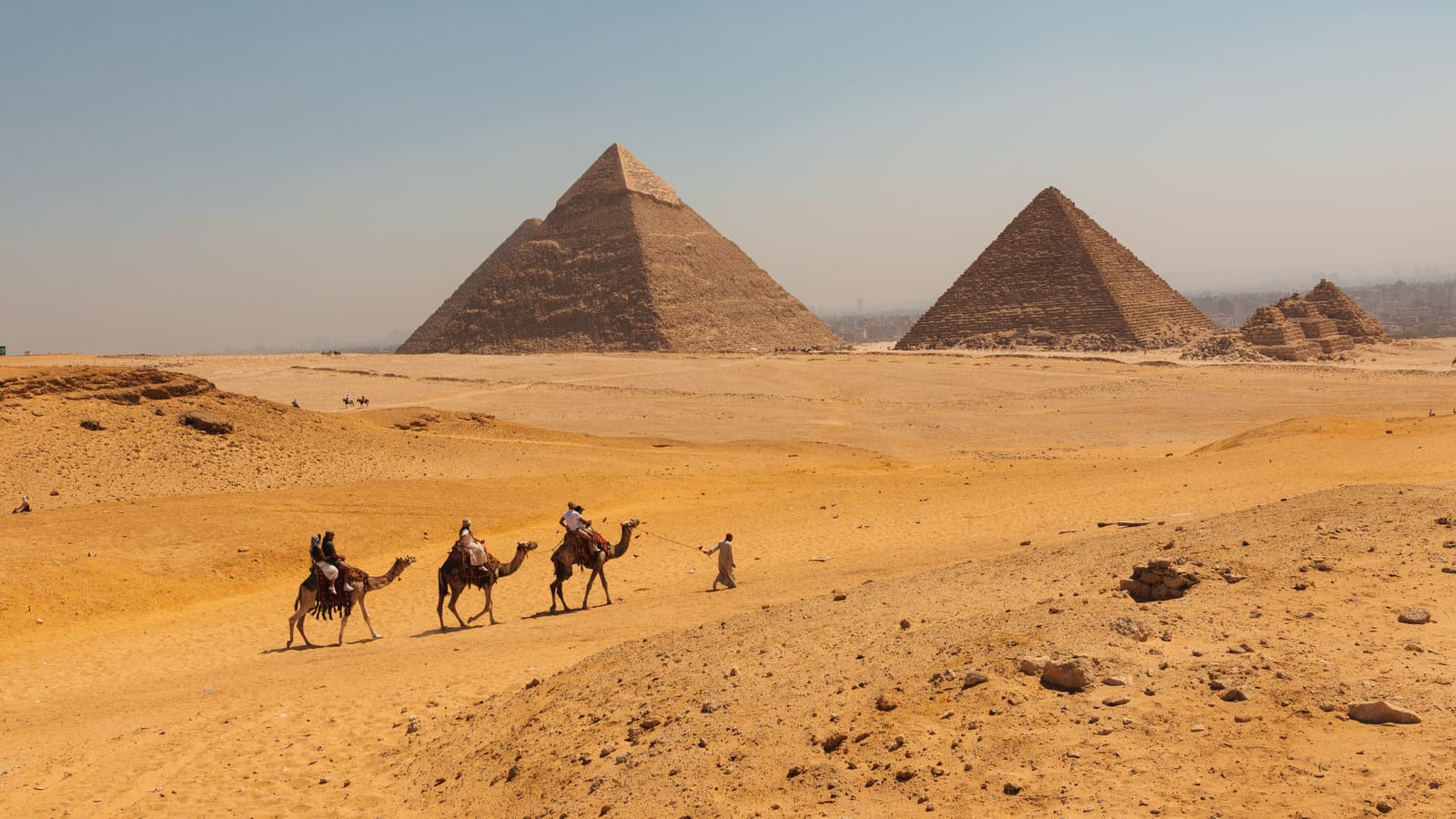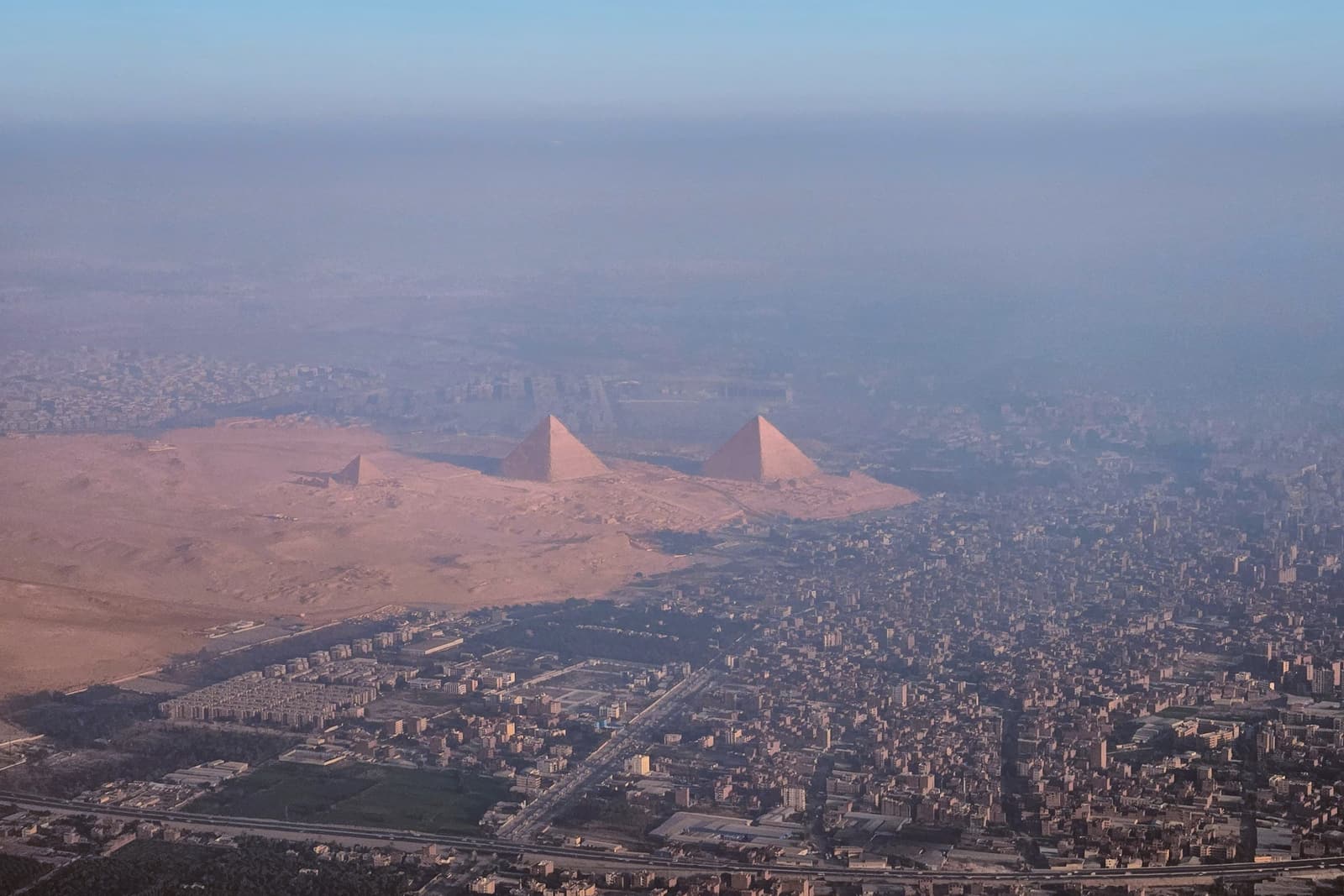
The pyramids stand on the western edge of Greater Cairo, about 15 km from Tahrir Square and roughly 40 km from Cairo International Airport. Distances are short; journey times are not. Traffic decides everything, so the two golden rules are to travel early and to allow more time than the map suggests.
The main ways to reach the plateau
| From | How | Typical time | Good to know |
|---|---|---|---|
| Cairo Airport (CAI) | Pre-booked transfer, Uber or taxi | 45–90 min | East of the city; the ring road avoids the centre |
| Sphinx Airport (SPX) | Pre-booked transfer or taxi | 25–45 min | West of Cairo, the closest airport to Giza and the museum |
| Downtown Cairo / Zamalek | Uber, Careem or taxi | 30–60 min | Cheap by international standards; leave before 08:00 |
| Downtown by metro | Line 2 to Giza, then taxi | 50–70 min | Cheapest option; the metro does not yet reach the plateau |
| Giza guesthouses | On foot or short taxi ride | 5–20 min | Check which gate is open to pedestrians |
| Red Sea resorts | Organised day trip by bus or flight | Long day | From Hurghada or Sharm El Sheikh; an early start |
Which airport: Cairo (CAI) or Sphinx (SPX)?
Cairo International Airport (CAI) is the country’s main hub and where almost all long-haul flights land. It lies on the north-eastern side of the city, the opposite side from Giza. On a good run the drive to a pyramid-view hotel takes about 45 minutes; in the afternoon and evening rush it can take an hour and a half or more.
Sphinx International Airport (SPX) is a much smaller airport on the Cairo–Alexandria desert road, west of the city. It is by far the closest airport to the Grand Egyptian Museum and the plateau — typically half an hour or so by car. It handles a limited but growing list of flights, mostly low-cost carriers, charters and some domestic services, so check whether your airline uses it. Facilities and onward transport are thinner than at CAI: arrange a transfer in advance rather than relying on finding a car outside.
- Pre-booked private transfer: a driver waiting in arrivals at a fixed price is the calmest way to begin a trip to Cairo. See airport transfers.
- Uber and Careem: both work at Cairo International and are inexpensive. Follow the app’s directions to the pick-up area and ignore offers from drivers in the terminal.
- Airport taxis and limousines: available from desks in arrivals; agree the fare before you get in.
From central Cairo
Ride-hailing is the default. Uber and Careem are cheap, air-conditioned and spare you the negotiation; inDrive is also widely used, with fares agreed in the app. Set your destination to the “Great Gate” or the Grand Egyptian Museum rather than simply “the pyramids”, so that you are not dropped at an entrance that is closed to arriving visitors. White metered taxis are plentiful too — insist on the meter or agree a price first.
Drivers sometimes stop on the way to pick up a “friend” who turns out to sell camel rides or tours, or tell you that the entrance is closed and offer to take you to a stable instead. It is not true. Decline politely and ask to be taken to the official entrance.
By metro
Cairo’s metro is fast, cheap and has women-only carriages, but at the time of writing it does not reach the pyramids. The usual budget route is Line 2 to Giza station and a taxi or ride-hail for the last eight kilometres or so. A new line (Line 4) intended to link central Cairo with the pyramids area and the Grand Egyptian Museum has been under construction for several years; opening dates have slipped repeatedly, so treat any promised date with caution and check the current status before relying on it.
The new entrance: the Great Gate on the Fayoum road
For decades visitors drove up the hill beside the Mena House hotel and parked between the pyramids. That has ended. Under a new operating system introduced in 2025, the main entrance for visitors is the Great Gate on the Cairo–Fayoum road, on the south-western side of the plateau. Private cars, taxis and tour coaches now stop at a large car park outside the archaeological zone.
From the gate you pass through security into a visitor centre with ticket windows, toilets, cafés and an introductory display. Tickets are paid for by bank card only. Beyond it, a fleet of hop-on, hop-off electric buses — included in your ticket — runs a loop around the site every few minutes.
The electric bus stops
The exact route has been adjusted since the system opened and may change again, but the loop serves the main points of interest: the panoramic viewpoint, the pyramid of Menkaure, the pyramid of Khafre, the Great Pyramid of Khufu and the Sphinx. You may get off, look around and board the next bus as often as you like. Buses can be crowded mid-morning; in the cooler months it is perfectly pleasant to walk between Khafre, Khufu and the Sphinx, which is downhill.
Getting to the Grand Egyptian Museum
The Grand Egyptian Museum has its own entrance and car park on the Cairo–Alexandria desert road, about two kilometres from the plateau. A taxi or Uber between the two takes ten to fifteen minutes. A pedestrian link between the museum and the plateau has long been part of the plan; check locally whether it is operating before counting on it.
Day trips onward
Saqqara, Memphis and Dahshur lie 25–40 km south along the edge of the desert. There is no practical public transport: hire a car with a driver for the day or join a guided tour, which is usually the better value.